Industrial 3D printing: from prototypes to a real production tool
- Jan 29
- 2 min read
For many years, 3D printing was seen in industry as a technology useful only for prototyping : validating shapes, checking assemblies, or presenting concepts. Today, that perception no longer accurately reflects reality.
In industrial plants in the Bajío region and the rest of the world, 3D printing is already a production tool , operational support, and strategic solution to reduce costs, time, and external dependencies.
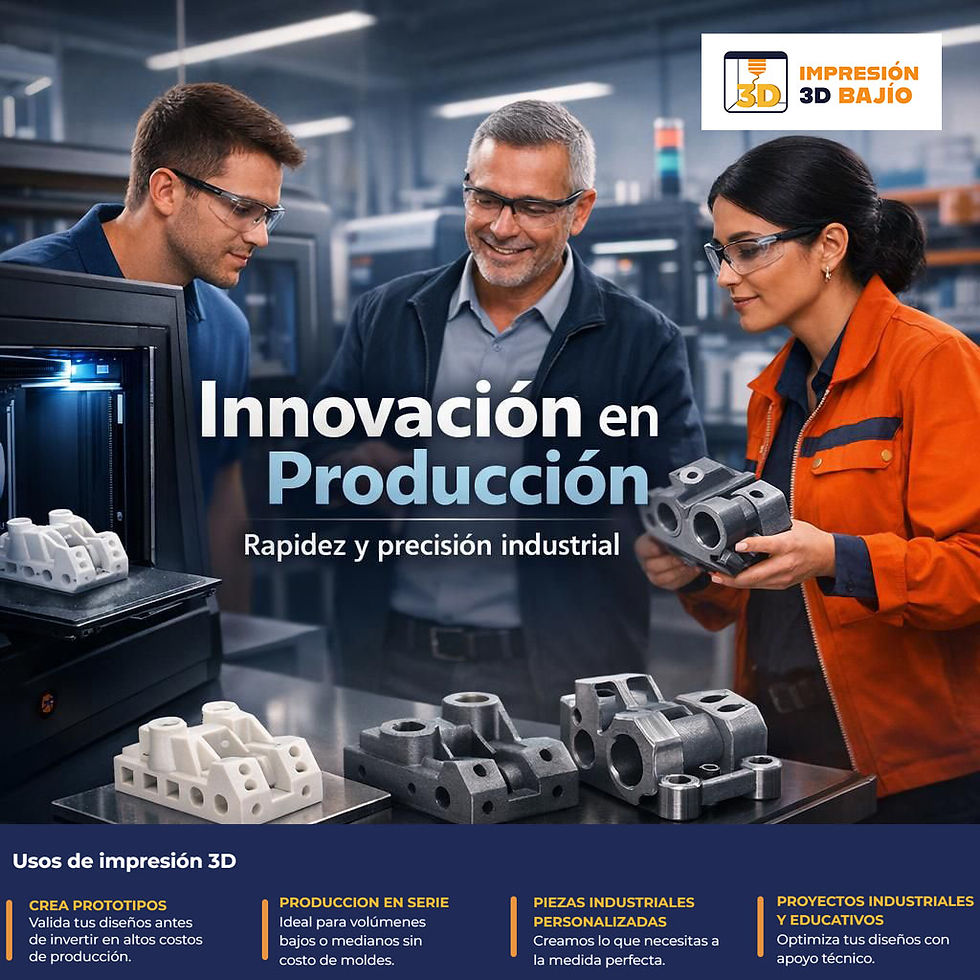
From “pretty prototype” to functional piece
The change didn't come solely from printers. The real leap forward occurred thanks to:
Advanced technical materials (carbon or glass fiber reinforced polymers)
Improved dimensional control and repeatability
Knowledge of design for additive manufacturing (DfAM)
Real industry needs : speed, flexibility and risk reduction
Today, 3D printed parts are used daily in factories such as:
JIGS and FIXTURES
Custom tooling
Replacement parts
Low and medium production functional components
And they do so with mechanical performance that was previously only associated with metal or injected plastics.
What really changed in industrial 3D printing?
1. The materials
We're no longer just talking about PLA or ABS. Materials such as the following are used in today's industry:
PA6-CF / PA6-GF
PPA-CF
PETG-CF
Polymers resistant to temperature, chemicals and fatigue
These materials offer:
High structural rigidity
Excellent strength-to-weight ratio
Dimensional stability
Performance comparable to certain engineering metals and plastics
2. The application approach
Industrial 3D printing doesn't compete directly with high-volume injection molding . It competes where it really hurts:
Constant design changes
Low or variable volumes
Long delivery times
High tooling costs
That's where 3D printing wins by technical knockout.
3. Time as a critical factor
While a mold can take weeks or months to create, a printed part can be ready in days or even hours . In production processes, time is money , and it's often the deciding factor.
3D printing as a production tool, not as an experiment
When implemented correctly, 3D printing allows:
Reduce line stoppages
Manufacture specific tools for each process
Iterate designs without financial penalty
Produce locally without depending on distant suppliers
This makes it an agile manufacturing tool , not an "extra".
So… who is industrial 3D printing for?
✔ Process engineers who need quick solutions
✔ Buyers looking to reduce total costs, not just price per piece
✔ Continuous improvement teams
✔ Companies with frequent engineering changes
✔ Projects where a mold is not justified (yet… or ever)
The most common mistake: comparing it incorrectly.
One of the most frequent mistakes is asking:
"Is it cheaper than the injection?"
The correct question is:
Is this the best solution for this point in the project?
In many cases, the answer is yes. In others, no. And that's precisely where the value of a correct implementation lies.
In 3D Printing Bajío…
We treat 3D printing as an industrial tool , not a generic service. We analyze the application, material, geometry, and production context to ensure the part functions properly in the factory , not just on a screen.
Contact me to chat more!
J. Antonio Ruiz
WhatsApp Direct:
Comments